Confident Headphone Mixing of Low Frequencies

Head-Related Transfer Functions and Headphone Processing
The Head-Related Transfer Function (HRTF) describes how sound is changed by the head, torso, and pinna as it travels from a point in free space to the ear canal entrance. It is the frequency domain effects of the impulse response that the person listening to the sound produces.
The head-related transfer function depends on the direction of the incoming sound in azimuth and elevation. To understand sound arrival in all directions, a HRTF dataset consists of hundreds of transfer functions measured across a full sphere of directions.
The HRTF encodes the directional cues that enable the auditory system to localise sound. These include the interaural time difference between the two ears the interaural level difference caused by the acoustic shadowing of the head. Both of these vary in frequency and are specific to an individual because our personal head shape varies. In addition, the colourations introduced by the pinna (external ear) reflecting sound add information of direction particularly at higher frequencies.
When listening to loudspeakers in a room, these cues help the listener understand the sound coming from the loudspeakers, enabling us to hear the recorded sound image, and in other directions, related to the sound decay in the room, giving us the sense of the room sound.

Binaural Rendering and Virtualisation
Headphones prevent the head-related directional hearing mechanism from working. Binaural rendering is the process of processing audio signals with HRTFs so that they can be directly presented at the ears, using headphones, resulting in a similar experience to listening to a set of loudspeakers.
Binaural rendering is done by convolving audio signals with a person’s HRTFs corresponding to the intended locations of virtual loudspeakers. The resulting signals, when delivered via headphones, recreate the perceptual directional cues in the original recorded audio and this results in the audio appearing outside of the head, with the recorded sound stage of audio recreated. To virtualise a pair of loudspeakers at say 30 degrees to the left and right, at ear height, in the standard stereo position, the left and right channel audio signals are convolved with four HRTFs, two from the left channel to the left and right ears, and two from the right channel to the left and right ears.

Low Frequencies
The room is a significant factor when listening to a loudspeaker system particularly at low frequencies. Aural ID technology offers a specific control for low frequencies that enable a familiar sense of envelopment, similar to the user’s experience on a loudspeaker system. The low-frequency 'Envelopment' control enables matching the binaural monitoring experience to the loudspeaker listening experience in a room, increasing the confidence in mixing and balancing low frequency content particularly when the low-frequency bass is not mixed to a centre-located mono signal but contains directional cues. The correct setting of the 'Envelopment' control depends on the reference loudspeaker system or internal learned expectation. There are two controls, 'Compensation' and 'Frequency Limit'. The 'Envelopment' processing is applied to frequencies below the ‘Frequency Limit’. The ‘Compensation’ adjusts the amount of crosstalk between the left and right ear at these frequencies.

In conclusion
Aural ID binaural rendering is an effective, convenient and accurate way of replacing or complementing loudspeaker-based monitoring. With the 'Envelopment' control the Aural ID rendering can become accurate and predictable also for low-frequency mixing and balancing tasks, widening the applications for HRTF-based binaural monitoring to all aspects of audio production workflow.
About the Author
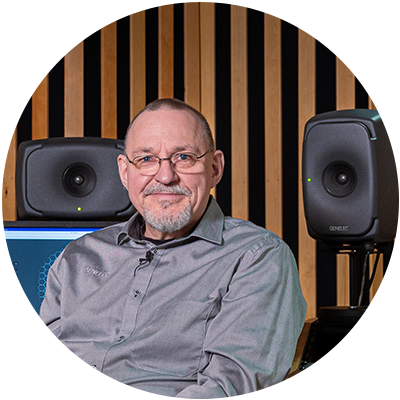
Aki Mäkivirta joined our R&D team in 1995 to pioneer the creation of the original 8200 range – our very first Smart Active Monitors – finally becoming R&D director in 2013. Aki is universally recognised throughout the audio industry as a multi-talented technology leader, a published researcher and a knowledgeable lecturer, and he has greatly contributed to our global success and to many technical innovations in his field of expertise.